Who Are We?
Welcome to the Optimization for Artificial Intelligence (OptimAI) Lab in the Department of Electrical and Computer Engineering at the University of Minnesota. Our goal is to develop principled optimization algorithms that advance artificial intelligence, information/signal processing and machine learning systems, bridging the gap between theoretical foundations and practical applications.
Our research focuses on:
- Theoretical Foundations: First-order and zeroth-order stochastic algorithms, momentum-based methods, bi-level optimization, min-max optimization, and equilibrium analysis for noncooperative games.
- LLM & Diffusion Applications: LLM agents, alignment for large language models and diffusion models, parameter-efficient fine-tuning, and scalable training algorithms.
- Robust & Private ML: Robust machine learning, inverse reinforcement learning, differential privacy, and federated learning.
Open Positions
We have research assistant and postdoctoral fellow positions available in the general areas of optimization, diffusion models, and LLM. If you are interested, please contact Dr. Hong.
News
| Nov 10, 2026 | A new paper AutoScaffold: AI-Guided Scaffolding for Reinforcement Learning of Language Models, joint work with Zijian Zhang, Rizhen Hu, Jon, Shiyang Li, Sujay Bhatt and Sihan Zeng, is available here. In this work, we let a frozen teacher model review the student’s training attempts, identify where it gets stuck, and write training-time hints – both strategies shared across task types and hints for individual hard tasks – which are then removed at evaluation. 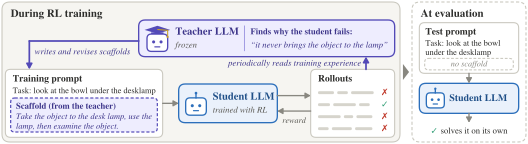 |
|---|---|
| Nov 06, 2026 | M. is co-organizing the new Optimization x AI Forum, an online seminar series on how AI can advance optimization research, covering AI for optimization modeling, for algorithm design, and for optimization theory. The forum is organized jointly with Niao He (ETH Zurich), Asu Ozdaglar (MIT), Zaiwen Wen (Peking University) and Stephen Wright (University of Wisconsin-Madison). Sessions are held every two weeks on Fridays at 15:00 UTC over Zoom, each with one or two talks followed by a 20-minute discussion. The opening talk, AI and Optimization in 2026: Reflections on a Revolution, was given by Stephen Wright. Upcoming talks, recordings and the speaker proposal form can be found here. |
| Oct 27, 2026 | A new paper MuonGS: Pretraining LLMs with Relaxed Weight-Norm Control, joint work with Athanasios and Dawei, is available here. In this work, we use a Gram-Schmidt projection to remove the radial component of each Muon update without pinning the weight norm, show that the resulting weight norm grows at most on the order of the square root of the number of training steps, and obtain lower validation perplexity than MuonH at long training horizons. 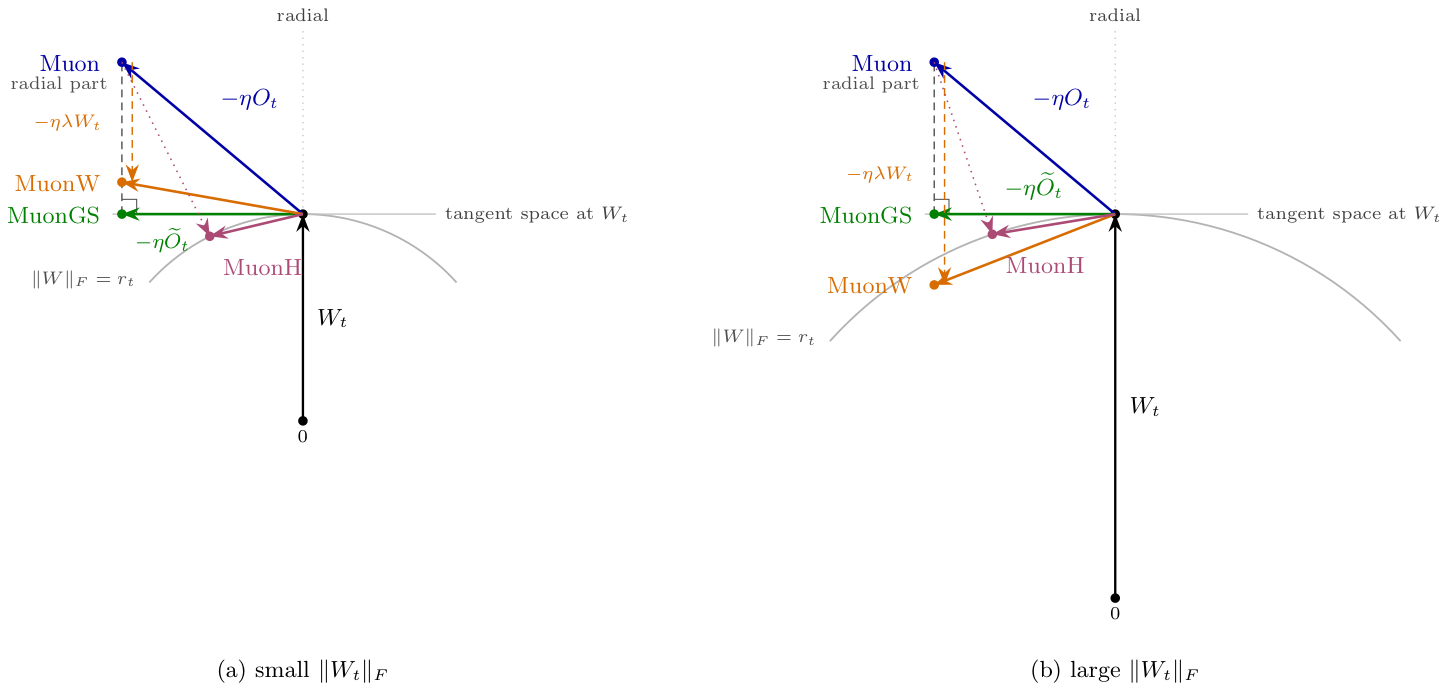 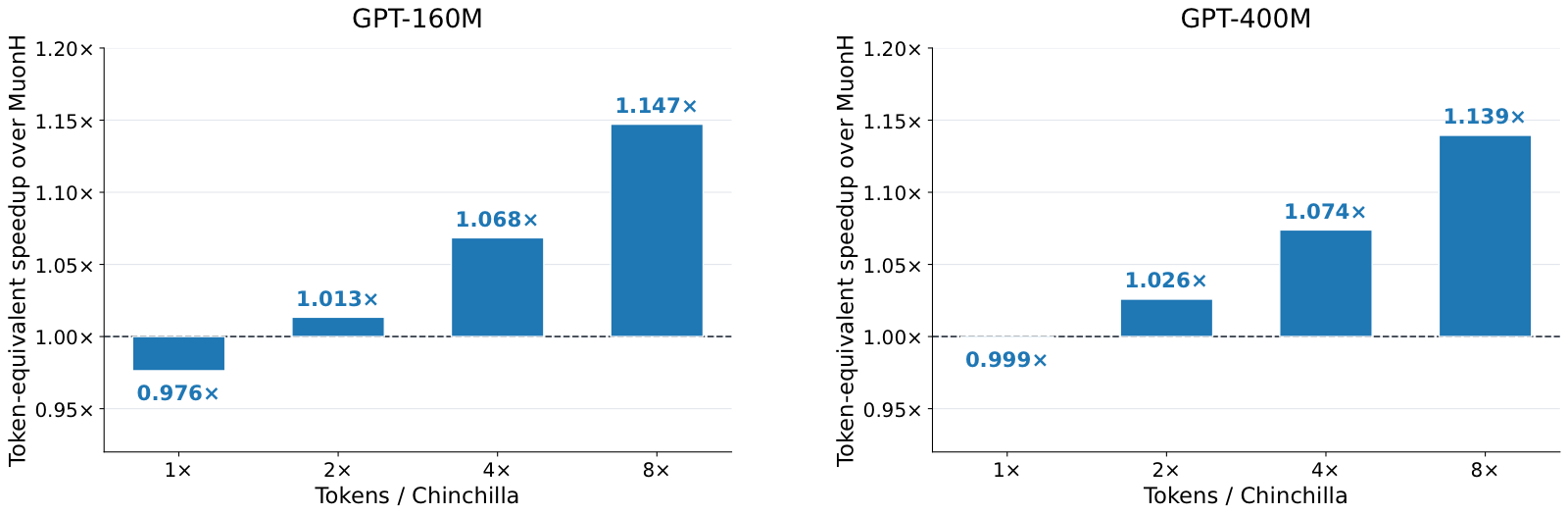 |
| Sep 18, 2026 | M. gave a seminar at the Department of Electrical and Computer Engineering at the University of Virginia, titled “Optimization for Large Language Model Pre-training: New Algorithms, Theory, and Insights”. The talk covered SCALE, a minimalist optimizer built on SGD that matches Adam while using a fraction of its memory; an analysis of why plain SGD struggles in LLM pre-training, and how simple clipping mechanisms close most of the gap; and EMA-Nesterov, a stabilized variant of Nesterov’s lookahead that consistently improves Adam, SOAP and Muon on pre-training benchmarks. The seminar announcement can be found here. |
| Sep 01, 2026 | Three papers accepted by NeurIPS 2026. Congratulations to everyone!
|
| Sep 01, 2026 | A new grant Automatically Discovering How Heterogeneous Agents Collaborate: Planning, Coordination, and Evolution for Multi-Agent Embodied AI Systems is awarded by Cisco (joint work with Katie). In this work, we make the collaboration itself the object that is learned: given a pool of heterogeneous agents and a task, we automatically discover and continually evolve who collaborates with whom and through what protocol, using hierarchical reinforcement learning with explicit credit assignment, and extend the framework to embodied multi-robot teams. |
| Jul 14, 2026 | A new paper Generating Developable 3D Molecules via Pocket-Conditioned Diffusion and Property-Aware Optimization, joint work with Jon and the group of Xia Ning (Ohio State University), is available here. In this work, we study structure-based drug design, and propose a diffusion framework that generates ligands optimized jointly for predicted binding affinity and favorable ADMET properties. 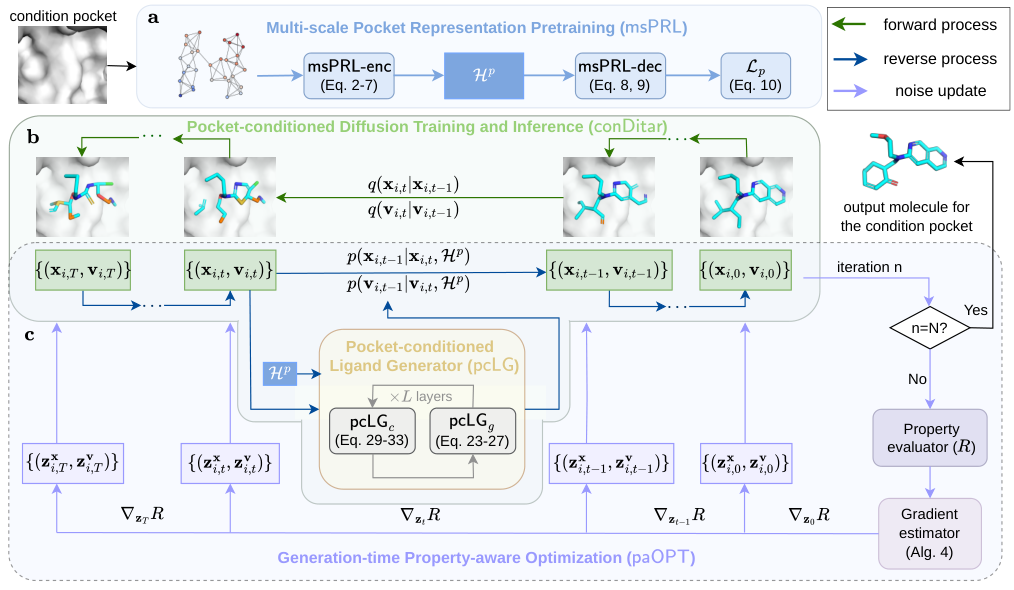 |
| Jul 01, 2026 | A new paper Is One Layer Enough? Training A Single Transformer Layer Can Match Full-Parameter RL Training, joint work with Zijian Zhang, Rizhen Hu, Athanasios, Dawei, Oscar and Hongzhou Lin, is available here. In this work, we study how the gains of RL post-training are distributed across the layers of a transformer, and find that training a single well-chosen layer – typically one in the middle of the network – recovers most of what full-parameter RL achieves. 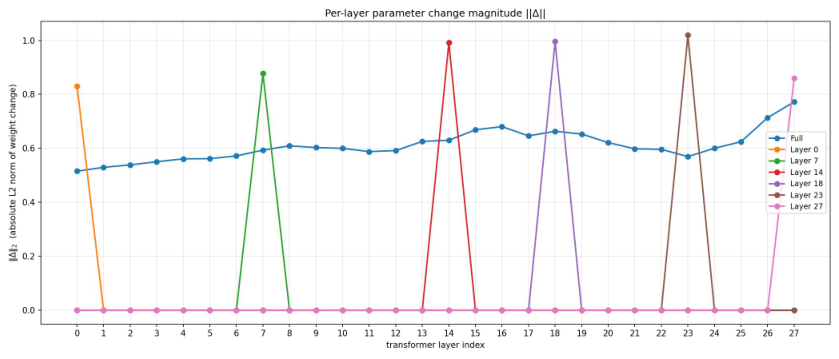 |
| May 22, 2026 | A new paper On the Nature of Regularity Assumptions in Bilevel Optimization with Constrained Lower-level Problem, joint work with Xiaotian, Chuan and Shuzhong is available here. In this work, we study the regularity assumptions underlying bilevel optimization when the lower-level problem is constrained. |
| May 20, 2026 | Welcome Dawei Li to the group as a post-doctoral researcher! |
| May 15, 2026 | M. gave a talk at the Department of Industrial Engineering and Management Sciences (IEMS) at Northwestern University, titled “When Classical Optimization Meets Modern Foundation Models: New Algorithms, Theory, and Insights”. The slides can be found here. This talk included a few of our new results, including an interpretation of SGD, and making Nesterov’s lookahead momentum work as a “harness” to accelerate pretraining algorithms (see here). |
| May 01, 2026 | Five papers accepted by ICML 2026. Congratulations to everyone!
|
| Mar 20, 2026 | M. visited the Department of Industrial Engineering and Operations Research (IEOR) at UC Berkeley and gave a talk on recent advances in bilevel optimization. |
| Mar 15, 2026 | Our paper BLUR: A Bi-Level Optimization Approach for LLM Unlearning has been accepted to EACL 2026 (Proceedings of the 19th Conference of the European Chapter of the Association for Computational Linguistics, Volume 1: Long Papers). Joint work with Hadi Reisizadeh, Jinghan Jia, Zhiqi Bu, Bhanukiran Vinzamuri, Anil Ramakrishna, Kai-Wei Chang, Volkan Cevher, Sijia Liu, and Mingyi Hong. Code available here. |
| Mar 01, 2026 | Together with Dr. Jiaxiang Li, M. organized three sessions at the INFORMS Optimization Society Annual Meeting (March 2026): two on optimizer design and benchmarking for LLM pretraining, and one on bilevel optimization.
|
| Feb 01, 2026 | Our tutorial paper Aligning Large Language Models with Human Feedback: Mathematical Foundations and Algorithm Design, joint work with Siliang, Luca, Chenliang, Jiaxiang, Volkan (EPFL), Stephano (Stanford), Markus (Google) and Alfredo (TAMU), has been accepted by SPM. |


